Full model and endpoint suiteThe complete supported MLTox model bundle and endpoint suite are provisioned on the appliance.
On-premises appliance
Put the full MLTox stack on-premises
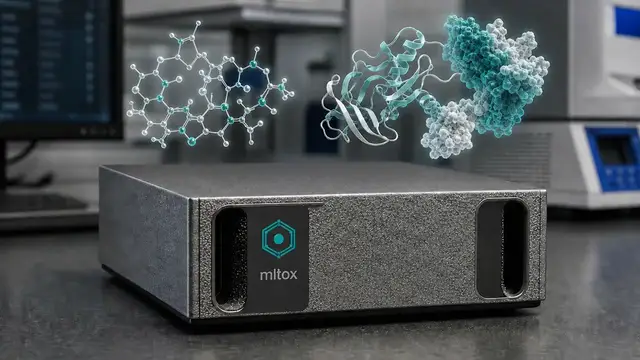
Deploy models, endpoints, discovery, and conversation on an NVIDIA DGX Spark appliance inside infrastructure you control.
Local discovery and conversationAn industry-grade LLM supports scientific discovery and report-grounded conversation in the same environment.
Controlled updatesModel and LLM releases can be reviewed and applied under the agreed validation process.
One input surface, separate science
One input. The right analysis. A result you can inspect.
MLTox detects the submitted format before analysis. Small molecules and protein sequences never share an inappropriate scoring path.
-
01
Submit
Draw a structure, type a public name, paste SMILES, InChI, MOL, or FASTA, or upload a controlled library.
-
02
Detect & featurize
Format routing sends small molecules to molecular descriptors and proteins to the sequence-liability pipeline.
-
03
Model predicts
Small-molecule results carry chemical applicability and classifier or regression uncertainty; biologics results carry panel and model metrics with modality-specific caveats.
-
04
Review, ask & feed back
Inspect the structured report, ask grounded questions, and attach authorized laboratory outcomes where supported.
Self-hosted · isolated · your environment
A prediction loop that can learn from authorized outcomes
The self-hosted path keeps scoring, report data, the feedback store, and eligible retraining inside the customer-controlled boundary.
Customer-controlled environment
Prediction
Input
SMILES · MOL · FASTA
Detect & featurize
Format router
Models
QSAR · biologic analysis
Safety report
Evidence · limits
Learning loop · your authorized data
Weighted retrain
Seed data + accepted feedback
Feedback store
Local · source-weighted
Laboratory outcomes
In vitro · in vivo · assay
How the loop closes. A prediction becomes useful evidence only after a real result returns. Authorized outcomes are stored with source context and can be folded into a versioned retrain over seed data plus accepted feedback.
Scope stays explicit. Feedback retraining applies to eligible small-molecule endpoint models. Broad biologics outputs do not retrain automatically; optional peptide and allele confirmations can seed epitope-model retraining.
Data boundary
Know what stays local and what may cross the boundary
On the DGX Spark configuration, inference, endpoint outputs, report generation, and the appliance LLM can remain local. Optional name resolution and live-literature retrieval may still create outbound traffic.
Molecular scoring and reports
Small-molecule models, sequence analysis, report generation, the feedback store, and eligible retraining can operate inside the deployed environment.
Explicit compound-name lookup
A typed-name resolution request sends that name to PubChem. Pasted structures and uploaded files do not require this lookup.
Explicit protein-name lookup
A typed protein name is sent to UniProt and may return a ranked candidate picker. Pasted sequences and uploaded FASTA files do not require this lookup.
Optional ESMFold weights
Public model weights may be downloaded once. They can be pre-staged where outbound runtime access is prohibited; submitted sequences are then scored locally.
Discovery and report conversation
The DGX Spark configuration hosts an industry-grade LLM for scientific discovery and report-grounded conversation. It does not compute endpoint predictions.
Live literature on cache miss
The configured Azure search service receives an identifier plus canonical SMILES, or a protein name plus sequence. Results are cached and cited; a no-source state remains visible when evidence is not found.
Frozen report links
Current shared views are read-only snapshots with no public chat. The capability URL itself grants access.
Coarse access controls
Shared password and IP allowlist controls are available, but they are not a substitute for per-user identity and authorization.
Review before sharing
Treat the link as sensitive. Confirm content, recipients, retention, revocation, and the approved deployment boundary.
Operating model
Choose a path, then verify the exact responsibilities
Deployment location is only one part of approval. Identity, retention, monitoring, support, validation, updates, and recovery still require an agreed operating model.
Managed path
Hosted
Best for teams whose scientific and enterprise requirements fit the reviewed hosted boundary.
- Confirm identity and tenant boundaries.
- Agree data use, retention, deletion, and support.
- Review integrations, monitoring, incidents, and updates.
Customer-operated appliance
NVIDIA DGX Spark
MLTox is delivered as a configured appliance with the full supported model and endpoint suite plus a local discovery and conversation LLM.
- Place it within your approved network and access boundary.
- Run endpoint inference, reporting, discovery, and report conversation locally.
- Review model and LLM updates through the agreed validation process.
Evidence before labels
Start architecture review
Certification, encryption, residency, uptime, and tenant-isolation claims must match the approved architecture and current evidence package for the specific deployment.
Confidential molecular IP
Use the public site for qualification, not proprietary inputs
Confidential structures, sequences, assay results, and program details belong only in a contractually and technically reviewed environment.
Public website
Share the product, stage, workflow, decision, and operating requirements needed to prepare a useful conversation.
Do not submit molecular structures, sequences, patient data, or confidential study results.Approved environment
Submit molecular data only after the hosted or self-hosted boundary, access model, data flow, and responsibilities are approved.
Review the boundary