Scientific decision workspace

mltox Platform

Run small-molecule and biologics analyses through the web portal, REST API, command line, or Python. Retain versioned analysis reports and deploy through the hosted portal or in infrastructure you control.

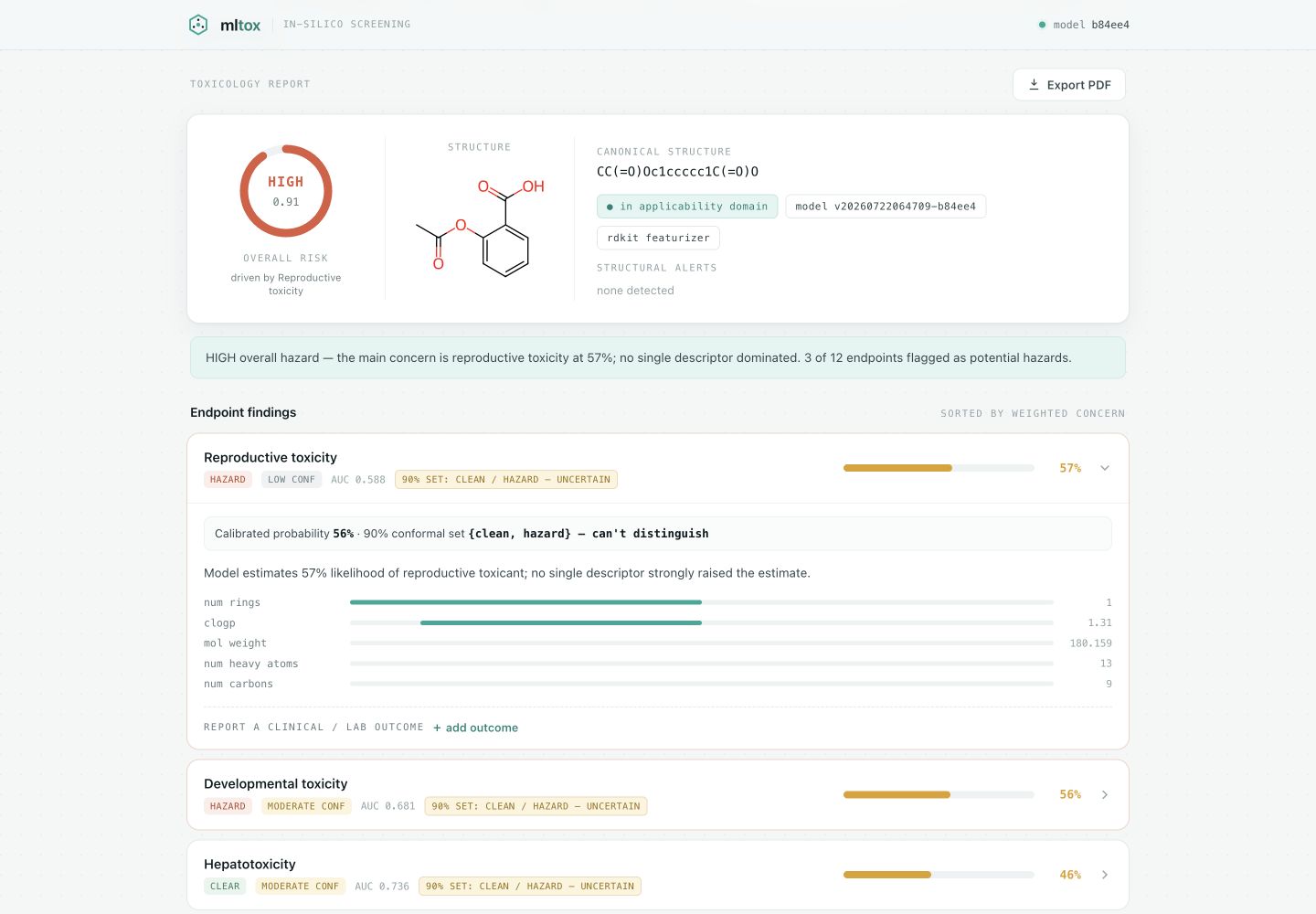
Current MLTox portal endpoint evidence view
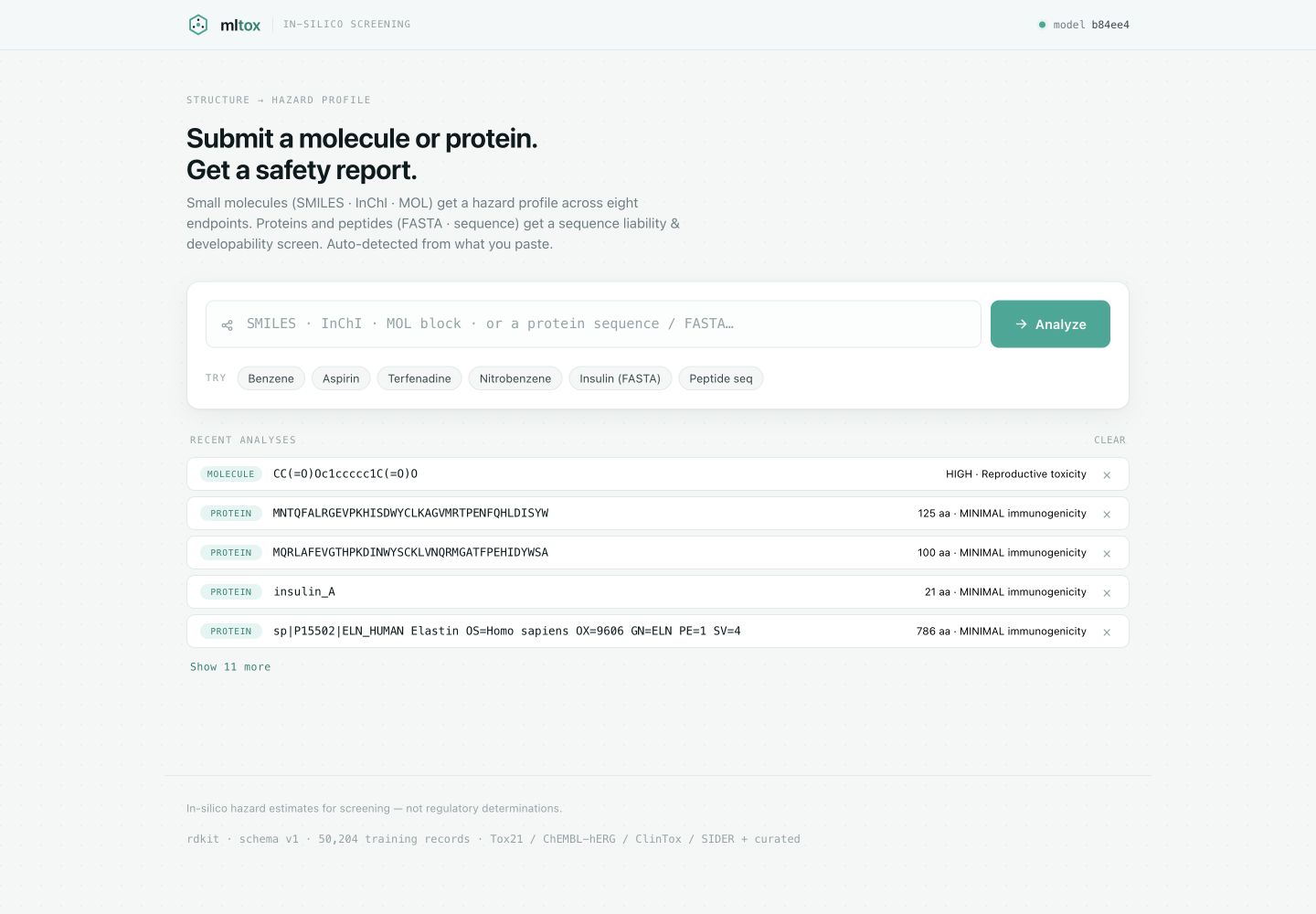
Current MLTox portal home workspace

Platform role

The platform supports the science. It does not replace the systems around it

mltox is a focused safety and engineering workspace for Small Molecule Safety and Biologics Engineering. It should connect with registries, ELNs, LIMS, scientific data platforms, modeling environments, and reporting workflows rather than become a generic system of record.

How AI and machine learning fit

MLTox is not one general-purpose AI model. It combines modality-specific trained models with established computational methods and explicit scientific boundaries.

Small molecules

Classical predictive machine learning

Production models use gradient-boosted classifiers and regressors to estimate endpoint-specific hazards, potency, and ADME/PK. Classifiers use isotonic calibration and split-conformal sets; regressors use cross-validated intervals; a chemical applicability gate scopes both.
Biologics

Binding models and structural context

Per-allele HLA-binding models sit alongside sequence-liability methods and optional ESMFold structure prediction. Outputs are design hypotheses, not clinical ADA predictions.

Computed evidence

Not every output is machine learned

Physicochemical calculations, structural alerts, labeled analogue outcomes, and sequence rules remain distinct evidence types. They should not all be called AI.

Report assistance

A separate language-model assistant

The assistant receives a report-derived fact sheet. It is instructed to explain completed results, label general background, and avoid computing the scientific predictions.

Implementation truth

Separate what exists from what still requires proof

Website language follows the observed product state and the evidence available for each capability. This keeps current product behavior distinct from scoped enterprise work and claims that still need approval.

CapabilityCurrent stateWebsite treatment
Web portal, REST API, CLI, Python library, and batch scoringShippedDescribe as current product interfaces.
Analysis history, versioned model bundles, and structured reportsShippedDescribe as analysis traceability, not an approval workflow.
PDF, JSON, QPRF, and endpoint-level QMRF outputsShippedShow as current evidence and reporting outputs.
Weighted small-molecule retraining and model registryShipped with limitsState that biologics models are excluded and governance is still limited.
Docker or Windows-service self-hosting and hosted portalShippedDescribe the observable deployment modes without adding compliance claims.
Per-user identity, roles, approvals, audit trails, and ELN/LIMS connectorsRoadmapPosition as scoped enterprise work until implemented and validated.

PLT-02 | Scientific workspace

Keep each result tied to its input, method, and evidence

The current platform preserves analysis history and report context. Reviewer assignment, approval state, rationale capture, and controlled return to an ELN or LIMS are sensible enterprise additions, but they are not presented as shipped features.

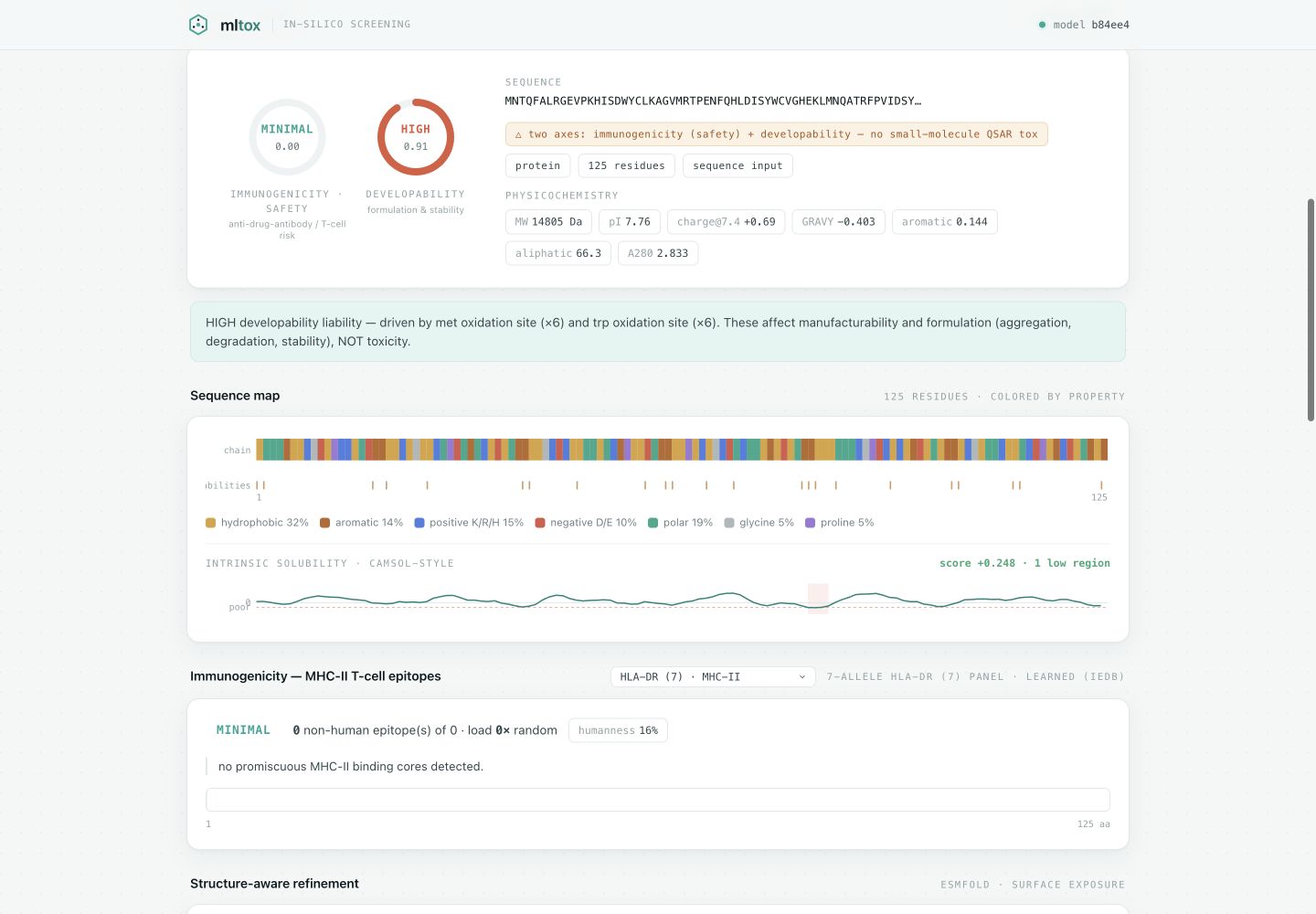
Real MLTox portal biologics report showing candidate identity, review results, and supporting context
A real portal record, shown instead of an abstract product mockup.
  • Controlled identityCompound, peptide, protein, construct, and source context.
  • Versioned methodProduct, model, data, software, and analysis versions.
  • Evidence stateResult, uncertainty, applicability, conflicts, caveats, and unsupported states.
  • Analysis historyStored analyses can be revisited without implying a formal reviewer or approval record.
  • Portable outputsPDF, JSON, QPRF, and QMRF outputs support scientific handoff outside the portal.

AI/ML feedback and model versions

A working feedback loop, with governance still to build

For small molecules, confirmed outcomes can be stored with source-based weights and used to retrain versioned endpoint models. Biologics models are trained separately and are not updated from submitted outcomes. The repository does not yet implement a formal challenger review, approval, or promotion workflow.

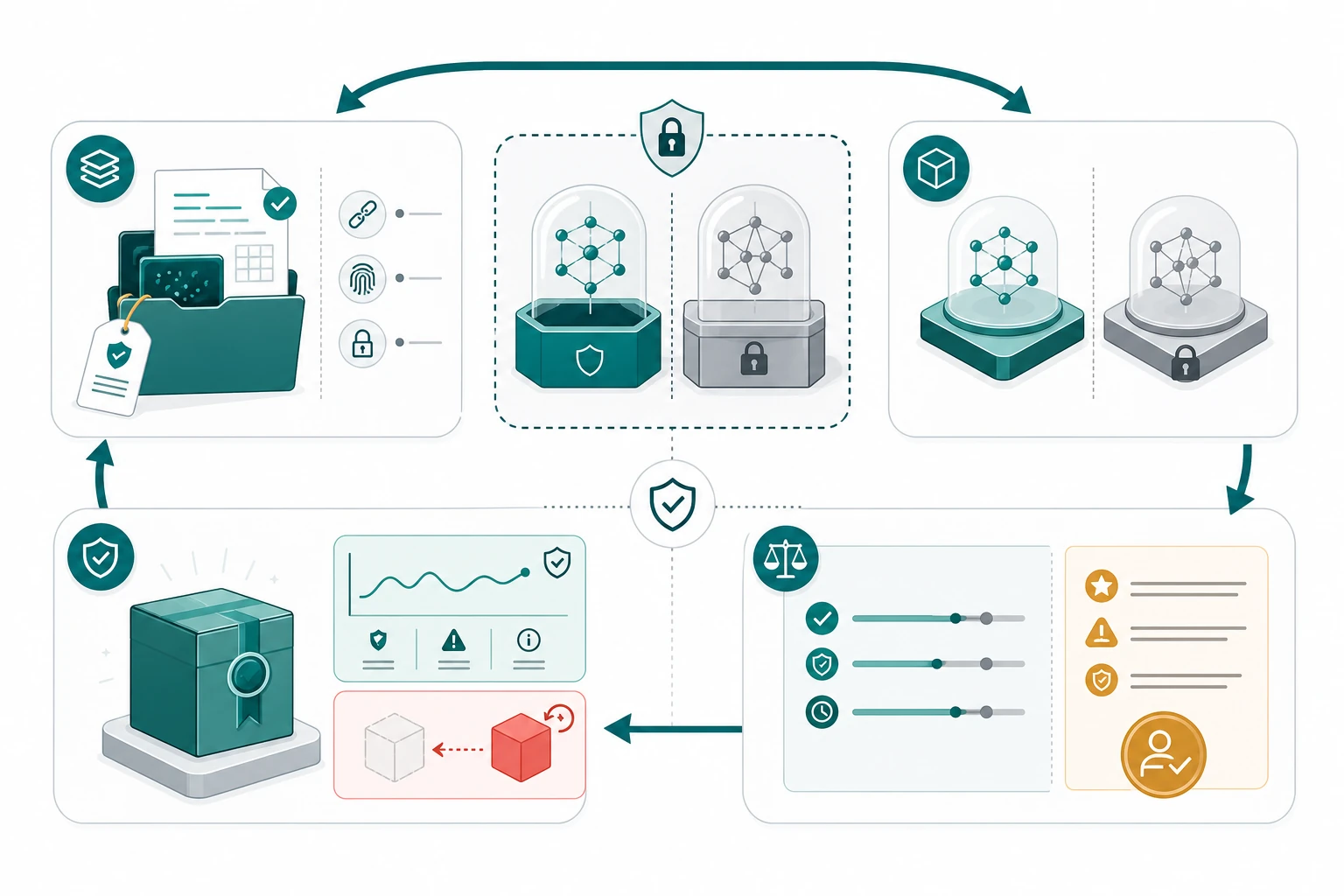
Governed model release loop with evidence qualification, protected production boundary, challenger comparison, approval, monitoring, and rollback
Recommended enterprise control layer. The current product provides weighted retraining and versioned model bundles; the protected challenger and approval path shown here is a roadmap design.
  1. Current: record an outcome

    Store an eligible small-molecule hazard outcome with its endpoint, observed result, source, and source-derived weight.

  2. Current: retrain and version

    Combine seed data with weighted feedback, rebuild endpoint models, and register a versioned model bundle.

  3. Next: compare a challenger

    Evaluate a candidate against protected validation evidence, calibration, subgroup behavior, and decision impact.

  4. Next: approve promotion

    Add named review, approval, monitored release, and rollback controls before treating retraining as governed production behavior.

Questions scientific teams ask about AI

Clear boundaries matter more than broad claims. These are the distinctions buyers and reviewers should be able to verify.

Does MLTox use AI and machine learning?

Yes. MLTox uses endpoint- and modality-specific machine-learning models alongside QSAR descriptors, chemical rules, analogue evidence, sequence methods, and optional structure prediction. It is not one universal AI model.

Does a language model generate the safety predictions?

No. Scientific outputs are computed before the assistant is invoked. The separate assistant receives a report-derived fact sheet, is instructed to label general background, and is instructed to say when candidate-specific evidence is absent.

Are all outputs calibrated and applicability-gated?

No. Eligible small-molecule classifiers use isotonic calibration and split-conformal sets; potency and ADME regressors use cross-validated intervals. A chemical applicability gate scopes small-molecule estimates. Biologics outputs use separate methods and caveats.

Does MLTox update itself from customer data?

MLTox does not learn continuously from inference. Small-molecule feedback retraining is manual by default and can be explicitly configured after a feedback threshold; each retrain creates a versioned bundle. Biologics models are separate and are not updated from submitted outcomes.

Does MLTox replace experimental testing or regulatory review?

No. MLTox provides research and preclinical decision support. Outputs remain hypotheses and evidence aids for qualified review, experimental follow-up, and applicable regulatory obligations.

Integration and evaluation

Use the available interfaces now; scope system connectors deliberately

The REST API, CLI, and Python library support programmatic scoring and report retrieval today. A direct ELN, LIMS, registry, or scientific data-platform connector should begin as one named handoff with explicit identity, metadata, version, ownership, and validation requirements.

Define one controlled handoff

Identify the source system, molecular identity, required metadata, assessment version, review owner, and destination. Treat connector development and write-back as scoped work until demonstrated.

Test science and operation in parallel

A functional champion tests the decision while an independent validator, Informatics, IT, Security, Quality, Legal, and Procurement review operation.