
Ranked candidate resolution
A typed protein name can open a ranked UniProt candidate picker. Pasted sequences bypass the external lookup, and short sequences route through peptide-aware handling.
Protein and antibody engineering
Compare sequence and structure liabilities before candidate lock, then focus the next engineering or assay decision.
The decision
Immunogenicity, aggregation propensity, sequence instability, intrinsic solubility, and structural exposure can create competing design hypotheses. Function, expression, measured biophysics, and clinical ADA remain experimental questions.
Map predicted HLA class I and II presentation signals, compare hotspots, and retain the relevant biological limits.
Inspect aggregation, oxidation, deamidation, isomerization, glycosylation, composition, and solubility hypotheses.
Use predicted structure and confidence to re-rank exposed, buried, or uncertain regions.
Review conservative substitutions predicted to reduce an epitope, then test function, binding, expression, and biophysics in the lab.
Current workflow additions
The current portal adds ranked UniProt name resolution, peptide-aware routing, cached cited literature, read-only share links, and asynchronous structure generation without changing the scientific boundary of the output.
A typed protein name can open a ranked UniProt candidate picker. Pasted sequences bypass the external lookup, and short sequences route through peptide-aware handling.
Cached literature stays attached to the candidate. A cache miss can call the configured Azure search service; a no-source state is shown when useful evidence is absent.
Broad biologics outputs do not retrain automatically. Optional peptide and allele confirmations can seed epitope-model retraining when explicitly accepted.
BIO-01 | Immunogenicity screening
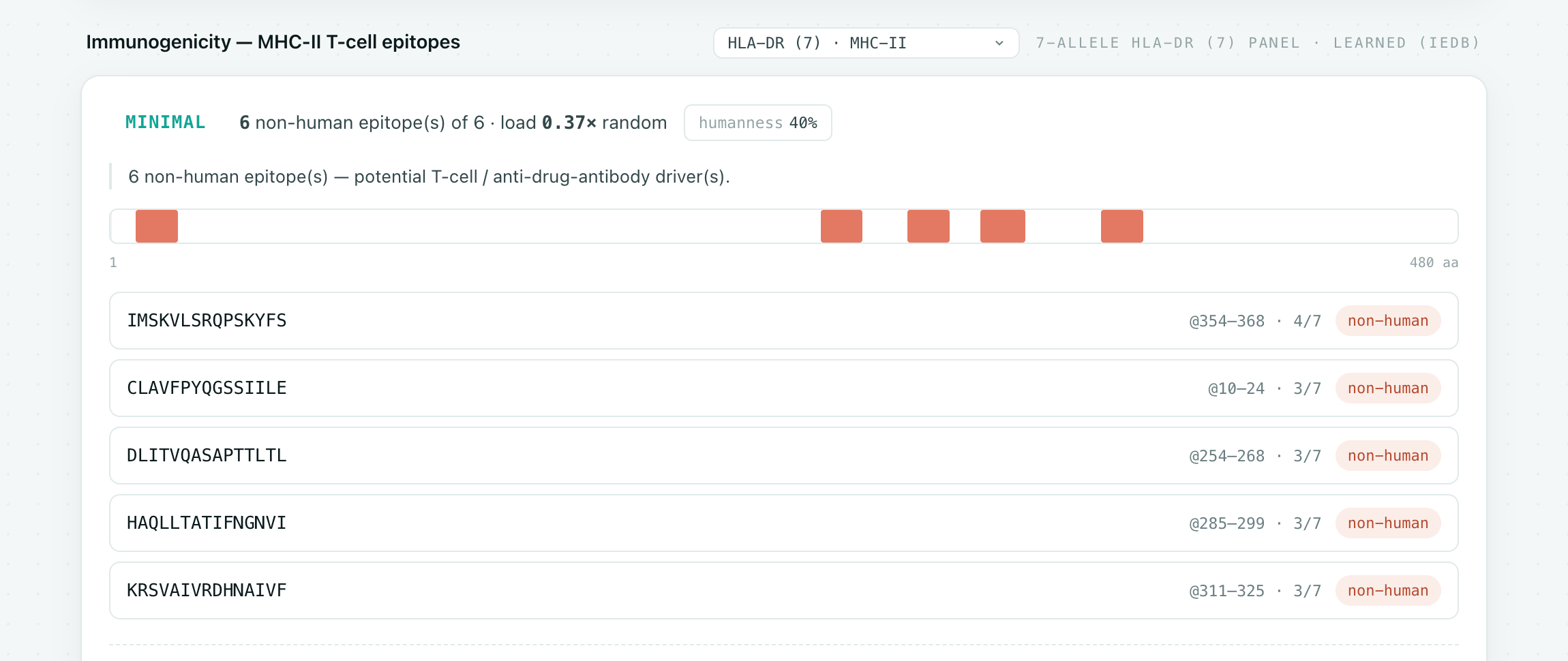
Use class-II epitope load and humanness as the primary ADA-related sequence signal, with a supplementary class-I panel. The output prioritizes review; it does not predict a clinical anti-drug-antibody rate.
BIO-02 | Developability
Review deamidation, isomerization, oxidation, glycosylation, cysteine, cleavage, fragmentation, and CamSol-style intrinsic-solubility flags together. They are sequence hypotheses, not measured manufacturability, formulation, or stability.

BIO-04 | Structure-aware refinement
When GPU folding is enabled, asynchronous ESMFold prediction adds confidence-aware exposure, selectable surface views, and a 3D review. Long chains may be split at linker-like regions; segment placement relative to one another is not predicted.
Portal interaction, public example. Drag to rotate and scroll to zoom. This embedded viewer uses the same self-hosted 3Dmol.js approach as the MLTox portal. The displayed structure is the public experimental HER2-trastuzumab Fab complex PDB 1N8Z; submitted MLTox sequences use predicted ESMFold structures and must be interpreted with pLDDT and exposure limits.
BIO-03 | Constrained sequence design
For a non-human epitope, propose conservative BLOSUM62 substitutions while fixing Cys, Pro, and glycosylation motifs. The model predicts epitope reduction only; every candidate requires functional and experimental validation.

The most useful result is a focused hypothesis with a clear experimental handoff, not an apparently complete verdict.
Prioritize sequence regions and constructs for review.
Patient-level and product-level clinical ADA rates still require relevant clinical and experimental evidence.
Compare predicted liability changes before testing.
Binding, activity, folding, expression, and stability must be checked after a proposed sequence change.
Expose regions that may merit developability review.
Solubility and aggregation under real concentration, buffer, process, and storage conditions remain experimental.
Focus the next engineering or assay question.
Sequence alone does not establish agonism, cytokine-release risk, target biology, or antibody polyreactivity.
Team workflow
Protein and antibody engineering
Review candidate tradeoffs while protecting functional regions.
Immunogenicity
Review HLA panels, hotspots, immune context, and assay strategy.
Developability and formulation
Carry sequence hypotheses into relevant biophysical and early CMC work.
Structural biology and design
Review confidence, exposure, interfaces, and what predicted structure omits.
Focused evaluation
Use representative sequences with known results or planned experiments. Define the HLA panel, liabilities, protected regions, structural comparators, assays, and success measures before analysis.
Discuss a biologics pilotJudge the workflow on