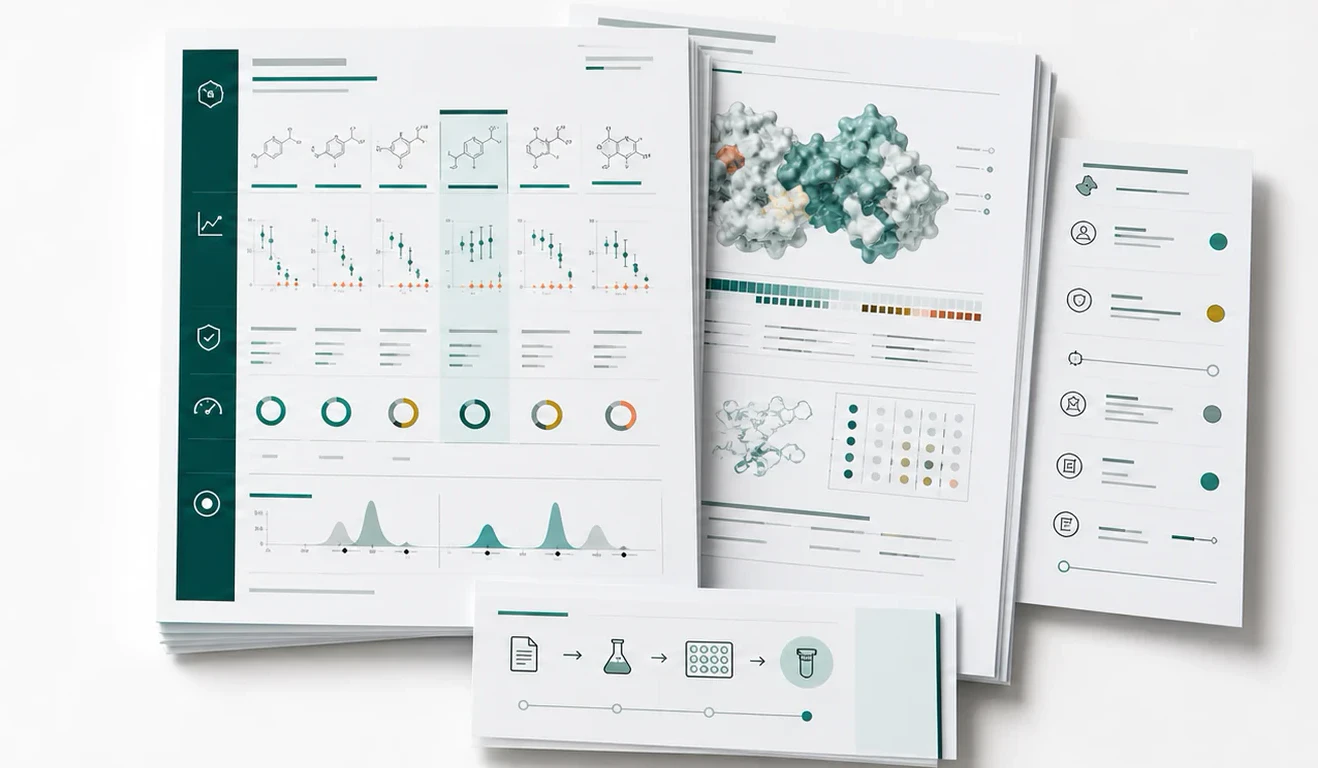
Interactive report
Portal evidence view
Hazard, potency, ADME/PK, physicochemical rules, nearest analogues, approved-drug percentiles, and a grounded report assistant.
Where mltox fits
The right tool depends on the modality, decision, evidence standard, deployment boundary, and operating model your team needs. This page makes those tradeoffs explicit.
Capability matrix
This is a workflow-level comparison, not a claim that every capability is equivalent in depth, validation, or intended use.
| Product | Small-molecule safety |
Biologics engineering |
ADME/PK and physicochemistry |
Visible uncertainty and applicability |
Read-across or reference context |
Regulatory-style documentation |
Self-hosted or on-premises |
Batch and programmatic access |
|---|---|---|---|---|---|---|---|---|
| mltox | Full | Full | Full | Full | Full | Full | Full | Full |
| ADMETlab 3.0 | ||||||||
| ProTox 3.0 | ||||||||
| ADMET-AI | ||||||||
| Toxometris.ai | ||||||||
| Optibrium StarDrop | ||||||||
| ADMET Predictor | ||||||||
| Schrodinger LiveDesign | ||||||||
| Lhasa Derek Nexus | ||||||||
| EpiVax ISPRI | ||||||||
| OPIG SAbPred / TAP |
Legend: full means the capability is a stated product function; partial means limited, indirect, module-dependent, or not presented with the same workflow depth; none means it was not identified in the reviewed public product material.
Comparison boundary: reviewed July 24, 2026 from public product pages and the mltox competitive-analysis library. Capabilities, packaging, and deployment options change. Validate any purchase-critical requirement directly with the vendor. This table does not compare predictive performance.
Example outputs
Review two synthetic teaching examples before sharing proprietary data. They demonstrate the scientific-review structure and the distinction between a model result, its supporting evidence, and the next experimental action.
Hazard, potency, ADME/PK, physicochemical rules, nearest analogues, approved-drug percentiles, and a grounded report assistant.
A readable report for scientific circulation and structured output for programmatic use or downstream transformation.
A per-molecule or per-endpoint prediction record with applicability-domain context, available as JSON, PDF, or editable DOCX.
An endpoint-level model record covering the OECD validation principles, available as JSON, PDF, or editable DOCX.
Loading report preview
Small-molecule example
Click through a ten-page synthetic concept report that keeps compounds comparable, opens endpoint evidence, separates supported, ambiguous, and unsupported cases, and records a proposed next action. It predates the complete 15-endpoint ADME/PK panel, approved-drug percentile radar, surfaced read-across, and QMRF/QPRF controls.
Loading report preview
Biologics example
Click through a ten-page synthetic candidate-review concept. It illustrates how immunogenicity, intrinsic developability, optional predicted structure, constrained design ideas, and an experimental handoff should remain distinct. It is not a validated clinical ADA or measured biophysics report.
Inspect the basis
These links are the starting points used to check modality and product scope. They do not substitute for technical diligence or a representative pilot.
Decision proof
A useful evaluation uses representative chemistry or sequences, agreed evidence, and a decision made before the next program milestone.
Use the molecular classes, novelty, edge cases, and file formats your team actually handles.
Agree which endpoints, confidence states, reports, and exports must be usable.
Inspect where methods differ, why they differ, and what experiment would resolve the uncertainty.
Test batch flow, API integration, deployment, identity, retention, versioning, and scientific review.
Focused evaluation
Bring a representative molecule or sequence, the current workflow, and the evidence your team needs to act.